

The User's Guide To Narcissism : Freud
To Be Drawn From the Abyss of No Dimensions

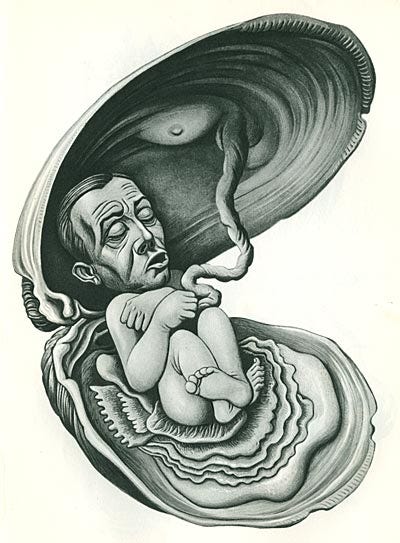
Infantilism, by Boris Artzybasheff
“All things in nature are what they are except for man, who, considered in himself, is not the thing that he is; for he imagines himself to be something in himself, but this is only a false idea of his.”
-Jakob Bril
There is a story that Herodotus relates in his Histories concerning Croesus, the fantastically wealthy king of Lydia. At one point, the great Athenian sage and legislator Solon came to visit him, and in anticipation Croesus assembled his many treasures in his palace. He led Solon through the hallways of munificent magnificence before asking him: who was the happiest man in the world?
Of course, Croesus was angling that it was him. But the obvious question arises, if he was so rich—why did he need Solon to tell him that?

Pic unrelated.
I.
Modern life has become suffused with psychiatric language. “Autism” has become a catch all term for every variety of personal eccentricity and interpersonal difficulty, everyone's ex-girlfriend is BPD, and every struggling kid has ADHD. Mental health itself is an ever growing preoccupation, the volume of psychiatric diagnoses is growing, the number of different types of diagnoses is growing. It has turned into its own form of identity movement, just take a look at whatever Freddie Deboer is angry about this week if you need another example.
Surely no word has had a more successful career in all this than “narcissist”. Boyfriends, parents, bosses, pick whomever you like, there’s someone willing to tell you they’re a narcissist if you pay them. Apparently they’re everywhere, but what does that mean?
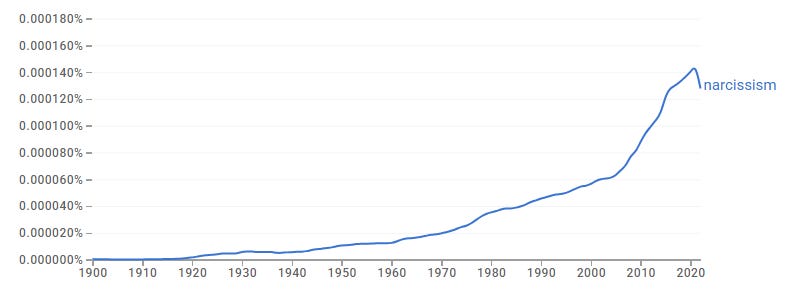
If it were a stock, I’d buy it.
Obviously people are prone to abusing this sort of language more than using it, but even within actual psychiatry the word has become somewhat meaningless. I would argue that “Narcissism” has come to be defined with specific reference to the characteristics of Narcissistic Personality Disorder, which means the term itself is self-referential. In other words, with “Antisocial personality disorder”, “antisocial” has a meaning outside of the context of the DSM. If the “N” in the NPD is itself referring to NPD, then “narcissistic personality disorder” really means “narcissistic personality disorder personality disorder” and so on.
Surely the word comes from the myth of Narcissus; he loved himself, so it's for people who love themselves too much. Not exactly, consider Dryden's rendition:
For as his own bright image he survey'd,
He fell in love with the fantastick shade;
And o'er the fair resemblance hung unmov'd,
Nor knew, fond youth! it was himself he lov'd.
The guy doesn't even recognize himself in the mirror, magpies can do that, what on earth could be going on?
Everyone seems to have forgotten it’s an old piece of Freudian jargon, but where we would now describe someone as “anally retentive” as a kind of joke, Narcissus and his mirror has lost none of its lustre. Why did Big Cig’s insight stick here and nowhere else?
If we’re going to use this word it behooves us to know what we’re talking about, so I want to wade into this thorny thicket of questions for your benefit. I picked up on the word from The Last Psychiatrist like everyone else, but I went down a rabbit hole of research on the topic. None of the secondary sources were really to my satisfaction so I had to go back to the primary sources and piece together the history for myself. The general understanding of the concept is fairly atrocious, which is forgivable because the history of the word is rather long and tortured.
This is not unusual. Since psychology is bullshit a developing science, definitions can be very slippery, their meaning seem to wash off of them quickly. Worse, since there isn't a real consensus on how psychology ought to be done, often there's clusters of terms for the same things from different schools of opinion, varying subtly in use and valence. In their original definitions, “narcissism”, “introversion” and “autism” all had very similar meanings, effectively they were the way different paradigms of psychology conceived of the same phenomenon. Now of course they’re completely separate in meaning. I wish I could give you a one sentence definition of “narcissism” but unfortunately for you and me, only that which has no history can be defined.
I want to delve more into the history of the word, to show how it has developed over time and to flesh it out more concretely than I’ve seen elsewhere. A little conceptual history, or perhaps, a genealogy.
Now, I didn't write this because I'm particularly worried about narcissists in my or your personal life. Maybe you/they/we/I are, that's not what's at stake here. To be honest, I’m more interested in the philosophical resonances of the concept than its merely psychiatric meaning; in a way, the word had a long history even before it crept out of Freud’s mind palace. As we’ll see, it has interesting resonances with existentialism, Marxism, Nietzscheanism and our predicament in this modern technological age.
Part of the great confusion is that there's usually no distinction made between the concept, i.e. the broader psychological phenomenon, and the narcissist as such, the personality type defined with reference to the concept. We’ll start with the concept, since its usage is complex enough.
II.
Strictly speaking, Paul Näcke coined the term in 1895 to describe a sexual fetish, but it was Sigmund Freud that really ran with it and started to push in the direction we use. The specific meaning for Freud is a little too complex to explain fully; it's tied up with Freud's libidinal theory, which is the basis of Freud's entire psychology, so you’d end up just recapitulating his whole theory of mind. But we'll take a stab at it, from this point on in this section all ideas are Freud’s, not mine—caveat lector.
In brief, Freud believed that ideas in the human mind are formed by physical investments (concentrations) of energy in the brain which correspond to prominence of the idea subjectively; an idea that seems important or is fixated in the mind is heavily invested. It’s a kind of capacitance, stored energy that can be released into the muscular system producing action. And here an idea can mean pretty much anything, usually it's an image of a person or a physical object, but it can also be an abstract concept. The investment can have a positive or negative valence; it can be love or hatred, corresponding to whether the idea represented is understood as a source of pleasure or pain.
Things that are sources of pleasure are usually objects out in the world, especially significant people, hence this libidinal investment is referred to as object libido. Crucially, people tend to have both positive and negative investments since loved ones also cause us pain occasionally, and these different representations need to be knit together to create a realistic image of them.
But human beings can also be autoerotic, sources of pleasure for ourselves. We can jack off, if you hadn't noticed. Since we can act as sources of pleasure for ourselves, we can invest in ourselves libidinally as well; this is narcissistic libido. This means human beings have ideas that are produced from interactions with the self, not the external world. Narcissism as such refers to this general tendency in the human mind.
That narcissism appears in a massive variety of places. If you try to read On Narcissism, then good luck because Freud is just bouncing all over the place without a clear through-line. Christopher Lasch calls it "seminal [sic] but confusing”, but we’ll try and work through it.
It starts with a primary narcissism corresponding to the earliest stages of mental development in human beings, prior to the emergence of a distinct self. Freud’s mind wants to discharge energy within it, the energy enters from sense organs or is injected in from deeper in the body, corresponding to needs like hunger. But in the womb, where the baby is fed umbilically there can be neither thought nor action. So prior to birth, all the baby knows is a complete tensionless nirvana.
This is the “oceanic feeling” that Freud identified in religion, a feeling of peace and unity with the world without a distinct self within it. It persists past birth because at the beginning of life there’s a coincidence between a baby’s instincts and its needs; the baby doesn’t know consciously when it’s born that it needs to feed, it just does it reflexively. I assume you haven't done it yourself recently, but take it from me: you actually have to suck quite hard to get milk out of a breast, so the baby has to enjoy the act of sucking in itself. Hence they also suck their thumbs.
If the baby had its way, it would be happy sucking its thumb forever. Of course, hunger cannot be satisfied in this manner so this eventually leads to a conflict and thus separation of the sexual (as Freud saw it) pleasure of sucking and the non-sexual satisfaction of the need to eat. This is the beginning of the separation of thought and action, ego and id, self and world. For a brief moment, it is drawn from the Abyss of Zero Dimensions. It’s that realization that it cannot satisfy this important urge by itself that causes the baby to turn outwards and start to “notice” the mother as a (somewhat) separate being, in a sense the first separate being in the world that the baby notices. Hence all the mOther bullshit in Lacan. Nonetheless, with the intervention of the mother the baby is sunk back into nirvana, for a short time at least.
But there’s also a secondary narcissism, where a person disappointed later in life by failures and frustrations falls back on their narcissistic investments at the expense of their object-investments. If you can’t form satisfying relationships then depending on the self seems a more reliable way to go. So secondary narcissism is the product of a defensive action; Freud compares it to how a person who is physically ill withdraws their interest in the external world, ceases to act and to love. Narcissus loved no-one, so the gods made him love himself; it's a bit like curling up into a ball so as to minimize the area exposed to the hostile external world.
Freudian narcissism actually reveals itself most strikingly in disorders like schizophrenia (the concept of a personality disorder did not exist at the time). This was Freud's explanation for the grandiose delusions that schizophrenics are sometimes subject to, you know how the classic delusion of “madness” is a guy who thinks he’s Christ or Caesar? You'll notice that the classic schizophrenic delusions; magical thinking, thinking that their thoughts are being caused by other people or that other people are reading their mind all involve a breakdown of the conceptual barrier between what is thought to be “inside” and “outside” the mind.
The meaning of this is that people aren’t born with a “theory of mind”, or even a “theory of body”. The idea that there’s a “you”, a distinct thing, that causes your own thoughts, and is controlling your own actions is something that you have to learn.
There's two aspects to this: the first is the understanding of the physical space of the body vs the external world. When the baby is born, it just feels pain, it can't tell the difference between an external pain (nappy too tight) and an internal one (teeth coming through). The Markov blanket needs to be calibrated. That mostly gets figured out by noticing how different sources of pain respond to action; things outside can be moved away from more easily, whereas the inside needs some kind of more indirect specific remedy, hunger needs feeding etc.
The second is the inside and outside of the mind as a conceptual space. Famously, kids have to figure out that other people don't know the things they do—they have to figure out that people's minds are separate, and can only be bridged by communication. This is key to understanding oneself as an agent, because it's only with this realisation that the kid realises that its thoughts and actions come from within.
Autoeroticism tends to blur those boundaries. When a baby is sucking its thumb it’s acting as an ersatz breast, so this part of the baby is subbing in for an external object and so the difference between the two is elided; “Narcissus loved himself, though he thought he loved another.” It’s like biological feedback, without hunger to break the spell the baby would get stuck in a loop forever—kind of like how Narcissus got stuck staring into that pool. The aptness of the myth is striking, if a little creepy.
So autoeroticism blurs the physical boundary of the body, but it also blurs the conceptual mental boundary. How this can happen is complex, and you’re not going to like the answer.
III.
You know where this is going, right? You’ve been waiting for him to rear his ugly blind head, so say it with me. The kid wants… something from the mother (or the father, Freud says it can be either). OK, the strawman is that the kid wants to have sex with the mother, that’s obviously not true, but the argument is more complex than that.
Remember that in a baby’s early life the parents do literally everything for them; feeding, diapers, entertaining, the lot, so the baby’s mind effectively revolves around the parents. But it also looks from the baby’s perspective that it is controlling the mother, that the mother isn’t a fully separate being. It gets hungry -> it screams -> it gets fed -> all good. At some level, it’s even true.
The baby wants to return to the nirvana of no desires, which union with the mother achieves for a time. The experience of union dissolves what’s there of the baby’s primitive self; hence the Lacanian concept of jouissance (specifically “the mother as jouissance”), it's an experience or feeling that will recycle you as a subject back into the primal unity of the world; it turns you into the orange goo from Neon Genesis Evangelion. It always comes from the mOther. That’s why it’s always transgressive and is defended against, the prohibition against it maintains you as a coherent subject.

Pictured : Man experiencing jouissance
But the baby notices that the mother doesn’t always come, not immediately at least. This creates tremendous anxiety, since the thing that everything good in the world depends on isn’t coming when you cry out. Maybe… the baby isn't really in control?
So now the baby has to think socially. Firstly there has to be an act of projection, that the thing is like you in some way. Or it's the other way around, that you are like this thing, but same difference. You want it, so it must want you. Therefore, the kid starts to build a model of what this thing wants with it so it can fulfil that and return to nirvana all the time. This is step 1, which everyone who isn’t a psychopath probably gets to.
Of course, there’s another thing there. Moving around, drinking beer and watching the Big Game. Presumably the mother shows affection to the thing as well (or you would hope), so there's a competition because all the goodness the baby thinks it’s supposed to be getting is being wasted on this interloper.
And so the baby is consumed with rage at this importuner, it's balling up its little fists. But it also creates an opportunity. Clearly the thing has… something the mother wants. And if it had that… something then maybe the mother would want the kid again?
How do you get the… something? The kid doesn’t actually know what it is so the kid reasons that if they become like the competing parent in general, then they might be desired by the ideal object. They take the father as a model, an ideal.
That ideal is a substitute for the primary narcissism the kid was trying to return to, the tensionless nirvana. Narcissistic pleasure starts off as masturbation, but eventually turns into taking pleasure in “being” something rather than “doing” something, a more dignified method of jacking off. Effectively, for the rest of their life when they perceive themselves as matching their ideal, there’s a little mummy buried deep in their brain smiling at them. It’s that sense of “if only I could do/be/have this then I would be happy”.
And that’s significant, because what the Oedipus Complex purports to explain, the reason why psychoanalysis stuck with it so long despite it being absolutely batshit, is the emergence of self-consciousness itself. By attempting to imitate the father the kid has to learn to self-observe, to view himself from the eyes of the Other. He has to observe the ideal, observe himself and then minimize the gap between the two, or what Karl Friston refers to as "surprisal".
That means the emergence of guilt. If I’m trying to live up to an ideal and I do the wrong thing, then I can’t be fulfilling it which will make me feel bad because mummy isn’t smiling any more. So I have to control myself, I can’t just kill the first man to annoy me and fuck the first woman I see.
The final step in the process is that the kid realizes he can’t actually be like the father. Because he’s like, four years old at this point? And if your dad isn’t a dick then this event is painful but not traumatic and you grow up with a realistic self image and don’t become cripplingly afraid of horses.
IV.
All acts of identification are narcissistic, based on this prototype. Identification is the process that moves the conceptual boundary of the self, by identifying you say this thing is part of me and I am part of this thing. It starts with parental identification but moves on to authority figures in general, religion and abstract ideas of justice. You can also identify with abstract concepts as well, “justice” but also qualities; “smart” or “blogger”.
Idealization is the pleasure of identification; any sort of person we admire is a representation of our ideal, and if we see a similarity between them and us, we’re matching the ideal. That means group identity is always narcissistic in nature as it’s based on an identification; if America = Cool/Powerful/Sexy and I am an American then I = Cool/Powerful/Sexy. The three main forms of group identity are national, religious and political/ideological, so all three are drawing on narcissistic libido.
Religion is the big one, since Freud was effectively a New Atheist one hundred years too early. It's not difficult to see that in Freud's conception the idea of God is a sort of half-remembered afterimage of that early period in which one is completely watched over by those all-powerful benevolent figures. The fundamental delusion of religion is that the world is somehow set up for our benefit, like it was in childhood, despite the obvious evidence that it is not. God is literally the Father, they aren't even trying to hide it.
Overall, there’s a continual opposition between the “self”, and the “external world” represented by objects. In group identity the distinction between the American and the other three hundred million Americans is elided. In psychosis, the conceptual boundary between the inside and outside of the mind is destroyed and so on. Narcissism always involves pushing, moving or destroying that boundary. Narcissism represents your “bullshit”, the parts of yourself you think are out in the world, and the things in the world you think are part of you. It represents informational entropy, feedback, “noise”, all those things we think we know that have no real reference in the external world.
But narcissism in this sense isn’t always bad. That complex of ideal self, observing agency and punishing guilt collectively is the Super-Ego, which really is the uniquely human part of the mind (Freud notes animals could be said to have an id/ego division). It’s the narcissistic pleasure of fulfilling an ideal that allows that characteristic human tendency of sublimation, to take pleasure in things other than our animal functions of eating and sex. That enables art, culture, even civilization itself.
Imagine a saint, going through privation, physical hardship, threat from authority etc. He can do that because he’s driven by this vision of his perfect self, complete apart from anything that the world can inflict on him.
Human beings are bewitched by this image of perfection, but one that impels us towards change in a manner that is rooted in biology, but not usefully reducible to it. It’s that biological and conceptual feedback, it allows a loop-like structure of self-interactions—self-consciousness. Which means the behaviour of the organism needs to be interpreted historically, that is, developmentally. Or so the argument goes.
Perhaps the strangest remark Freud makes is that sleep is a narcissistic state. So you don’t want to be a narcissist? Just stop sleeping bro. But the reasoning is simple; in sleep one is completely given over to the egoistic need for rest and access to the external world is completely cut off. One is left alone in the Interior Castle and all that is left are those phantasms and traces of the world that have snuck their way in in waking life. Dreams are the royal road to the unconscious because without the intervention of objective sense data, all that’s left in experience is that “internal” content, your “bullshit”.
Psychosis is caused by a similar process to the dream in waking life, it’s an extreme defence mechanism in which a mind assaulted by some powerful trauma violently severs the connections to the external environment (object investments) to limit the psychic damage. The actual delusions that are usually taken as the problem itself are actually attempts to reach back out to the world, to make sense of it after those other important ideas were violently ripped out. Effectively, only the investments that are a threat vector are cut off and delusions are a kind of pasting over the cracks using the material that remains.
V.
What are we to think of all this? Well, I’d say it’s mildly nuts. I’ve elided many details but trust me, it’s a masterpiece of deductive logic. Freud seemed to think that every single weird detail of human behaviour could be used to show some vital aspect of the swiss-watch ticking beneath your skull. Every observation ties into three or four more observations until you can barely keep this behemoth in your vision at a single vantage point.
But for the same reason it’s a prime example of High Modernist madness—the damned thing has more working parts than one of Hitler’s tanks. In the end Freud’s arguments are more seductive than convincing—you end up wanting them to be true because it would seem to explain everything… which is the problem.
So he might not have been much of a scientist, but as a myth maker, the man has no equal after Plato. Freud’s protoplasmic brain, grasping out at ideas, incorporating and digesting them and recoiling from them is fascinating. I’ve spent a lot of time reading Freud over the last year and it’s one of the most bizarre and interesting intellectual systems I’ve come across. A mind maze to lose oneself in.
Of course, all of this is very, very far away from your ex-boyfriend, or so it might seem. But that’s because there was about forty or fifty years of development before this set of ideas really turned into “narcissism” as we understand it today.
VI.
This is going to be something of a long journey, so let me leave you with a final question for today. If Freud is right that human subjectivity is formed in relationship to this ideal, is there a natural ideal to identify ourselves with or is it fundamentally an arbitrary thing? To put it another way, is there an essence of human beings or are we simply animals who have been taught to dance by treats and blows?
This is essentially a theological question, and I won’t give you my answer now. So consider instead a rather strange coincidence between a comment of Freud’s and a piece of medieval theology. Consider this paragraph in On Narcissism:
“Here we may even venture to touch on the question of what makes it necessary at all for our mental life to pass beyond the limits of narcissism and to attach the libido to objects. The answer which would follow from our line of thought would once more be that this necessity arises when the cathexis of the ego with libido exceeds a certain amount. A strong egoism is a protection against falling ill, but in the last resort we must begin to love in order not to fall ill, and we are bound to fall ill if, in consequence of frustration, we are unable to love.”
Narcissus loved no-one, so the Gods made him love himself, of course. Freud goes on to quote a fragment of Heinrich Heine on the topic. It’s in the voice of God himself, describing his motives for creation:
Krankheit ist wohl der letzte Grund
Des ganzen Schöpferdrangs gewesen;
Erschaffend konnte ich genesen,
Erschaffend wurde ich gesund

[‘Illness was no doubt the final cause
of the whole urge to create.
By creating, I could recover;
by creating, I became healthy.’]
This has a strange resonance in the work of the 10th Century philosopher Eriugena. Eriugena’s magnum opus is the Periphyseon, an elaborate metaphysical cosmogeny. Leszek Kolakowski summarizes Eriugena in this way:
Man, as a microcosm of creation, contains in himself all the attributes of the visible and invisible world . Mankind is, as it were, the leader of the cosmos, which follows it into the depths and back into union with the divine source of all Being. It is clear that Eriugena sees the creative act of God as a satisfaction of the creator's own need, and that he regards the circuit whereby creation returns to the creator as a process which restores God's nature to him in a form other than its original one. In one passage he actually puts the question: why was everything created from nothingness in order to return to its first beginning? Having stated that the answer to this question is beyond human understanding, he at once proceeds to offer an answer: everything was created in order that the fullness and immensity of God's goodness should be manifested and adored in his works. If the divine goodness had remained inactive and at rest there would have been no occasion to glorify it, but, as it overflows into the wealth of the visible and invisible world and makes itself known to the rational creation, the whole of creation sings its praises. Moreover, the Good which exists in and by itself had to create another Good that only participates in the original bounty, otherwise God would not be lord and creator, judge and fountain of all benefits (v. 33).
Thus the Absolute had to exceed its own boundaries and create a contingent, finite, and transient world in which it could contemplate itself as in a mirror, so that, having reabsorbed this exteriorization of itself, it might become other than it originally was, richer by the totality of its relationship with the world: instead of a closed self-sufficient system it becomes an Absolute known and loved by its own creation.
Or in Hegel’s adaptation of Schiller:
Only,
The chalice of this realm of spirits
Foams forth to God His own Infinitude